
Job costing
Job Costing Software for Manufacturers
Manufacturing job costing that finds out what each job actually cost in labour, material and machine time, compare it against what you quoted, and stop discovering your loss-making products at the year end.
Definition
What Is Job Costing Software?
Job costing software builds the true cost of an individual job from what it really consumed: the hours operators booked against it, the material issued to it, the machine time it used and the overhead applied to it.
The important word is actual. Almost every manufacturer has an estimated cost, because they quoted the work. Far fewer have the actual cost, which is the only one that tells you whether the quote was any good.
The uncomfortable pattern is consistent across UK manufacturers: a handful of products and customers are considerably more profitable than anyone assumed, and a handful are losing money on every order. Without job costing you are cross-subsidising and cannot see which way.
See it live
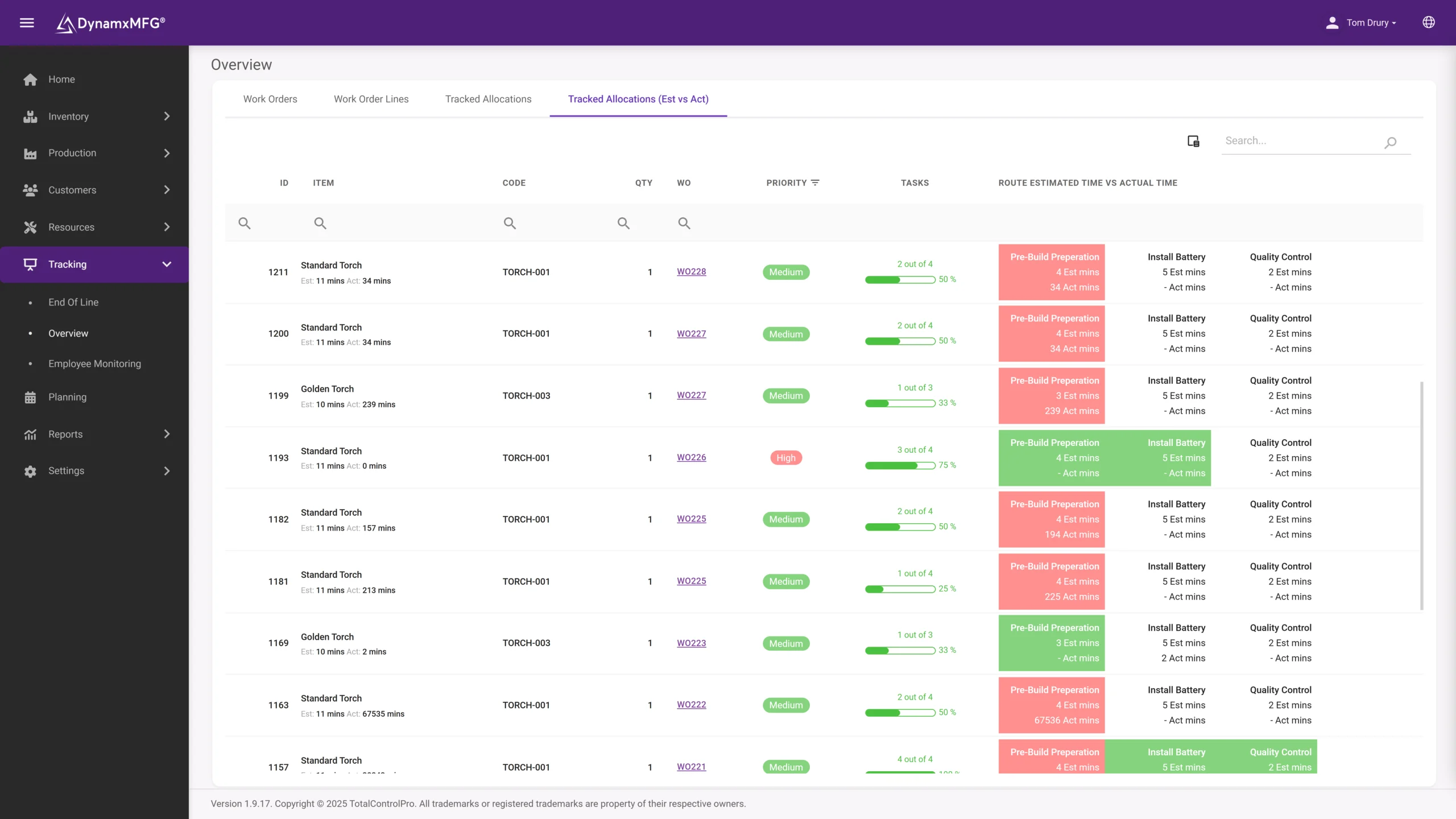
Actual Against Estimate, While the Job Runs
Every booking adds labour to the job, every issue adds material, and the comparison against the quote is live. No month-end reconstruction, no research project.
A job drifting over its estimate is visible mid-flight, while there is still something you can do about it.
- Cost building live on every open job
- Labour, material and machine streams separated
- Variance against quote per operation
How it works
How Manufacturing Job Costing Works
Four cost streams, collected against the works order, compared against what you said it would be.
Labour
Hours booked by operators against each operation, at the rate for that person or work centre. This is the stream most factories estimate rather than measure.
Material
What was actually issued to the job, at real purchase cost, including the material scrapped and replaced rather than just the theoretical BOM quantity.
Machine and overhead
Machine hours at their running rate, plus the overhead recovery your business applies. Getting the rate roughly right matters more than getting it perfect.
Compared to quote
The finished actual cost set against the estimate, so the variance is visible per job, per product and per customer.
Worked example
Estimated vs Actual Job Cost: A Worked Example
The numbers below are illustrative, made up to show the method rather than taken from any customer. Picture a batch of machined brackets quoted at £1,600.
| Illustrative example | Estimated | Actual |
|---|---|---|
| Labour at £45 per hour | 12 hours, £540 | 15.5 hours, £697.50 |
| Material | £380 | £410 (one bar scrapped and replaced) |
| Machine at £60 per hour | 6 hours, £360 | 7 hours, £420 |
| Total cost | £1,280 | £1,527.50 |
| Margin on £1,600 | £320 (20%) | £72.50 (4.5%) |
On paper this was a healthy 20% job. In reality it made 4.5%. The extra three and a half hours of labour did most of the damage, and without operation-level bookings nobody would know whether that was set-up, a second-off inspection or a problem on one machine. That breakdown is what makes the variance useful: it tells you whether to fix the quote, the process or the routing.
If the same bracket runs ten times a year with the same pattern, the next quote should change. We go deeper on closing this gap in tracking actual versus estimated job cost in high-mix manufacturing, and you can run your own figures through the job cost calculator.
Capabilities
What Job Costing Gives You
Actual versus quoted
Per job, with the variance broken down by labour, material and machine.
Cost by product
Which items consistently cost more to make than you charge for them.
Cost by customer
The accounts that look busy and turn out to be barely worth running.
Cost of scrap
Rework and scrap valued properly instead of disappearing into overhead.
Live work in progress
What has been spent on jobs still open, rather than a month-end estimate.
Better estimating
Historic actuals feeding the next quote instead of the last guess.
The bigger picture
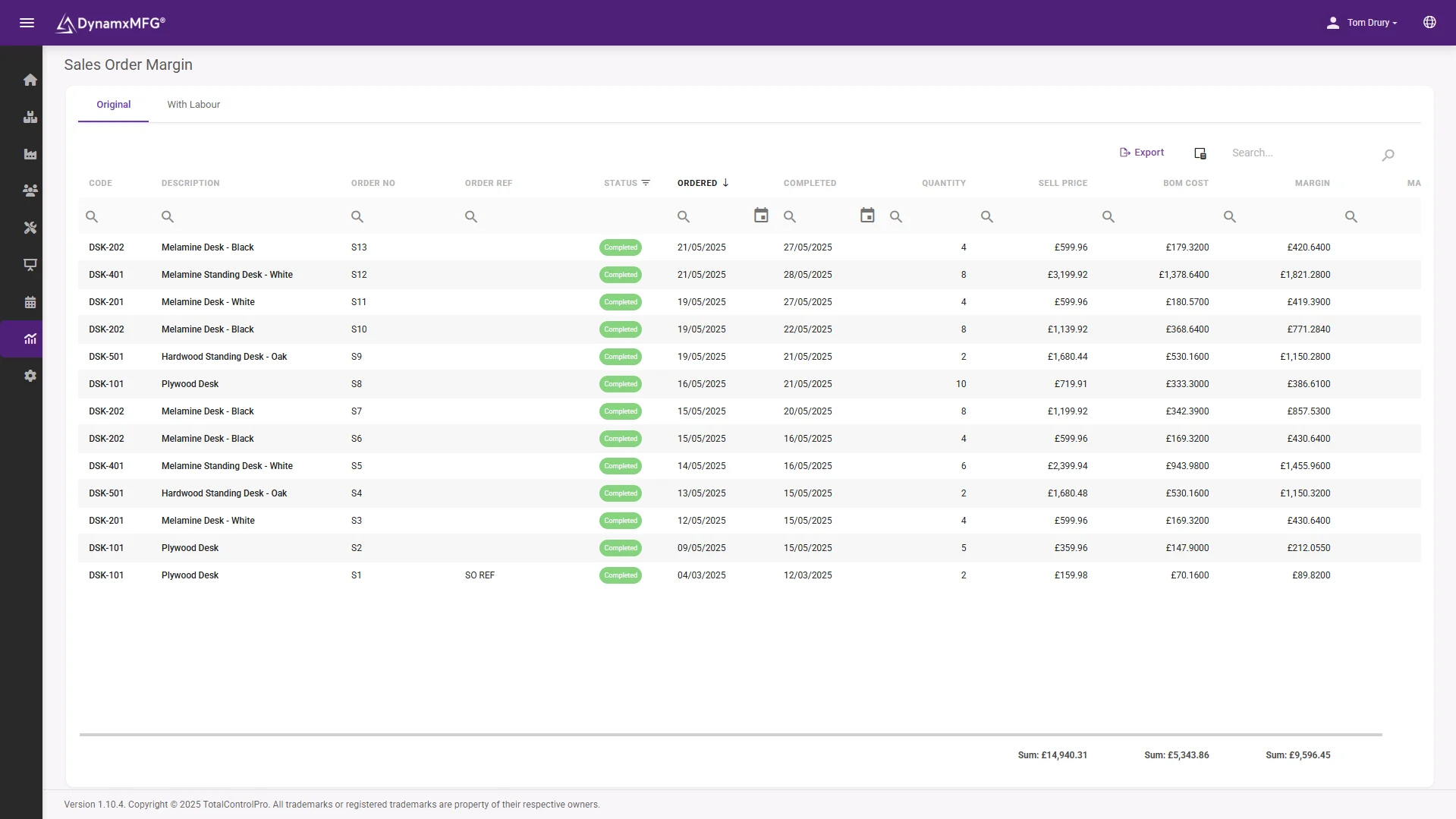
Margin by Order, Product and Customer
Roll the job costs up and the pattern appears: which products earn, which customers cost, and where the quiet cross-subsidy has been happening.
This is the report our customers most often say paid for the system - usually inside the first quarter.
- Margin per sales order
- Product and customer profitability ranked
- Export straight to your accountant
Benefits
What Job Costing Is Worth
This is normally the fastest financial return in a manufacturing system, because it changes pricing decisions rather than just efficiency.
Quoting stops being folklore
Estimates built on what similar jobs really cost beat estimates built on what somebody remembers. The improvement compounds with every job you quote.
You can walk away from bad work
Knowing a product loses money on every order gives you the option to reprice it or decline it. Most manufacturers find at least one.
Overtime gets attributed
When premium hours land on a specific job, you can see which work is quietly consuming your most expensive capacity.
WIP stops being a guess
Live job costs mean work in progress on the balance sheet reflects reality rather than an accrual somebody sense-checked.
Costing methods
Job Costing, Process Costing and Standard Costing
Which one applies depends on what you make. Manufacturers who make discrete, varied items almost always need job costing.
| Job costing | Standard and process costing | |
|---|---|---|
| Costs are collected against | An individual job or works order | A period, a process or a standard unit |
| Best suited to | Make-to-order, high-mix, bespoke work | Repetitive, high-volume or continuous production |
| Tells you | Whether this specific job made money | Whether the process is running to plan |
| Requires | Booking at operation level | Accurate standards and volumes |
| Variance shown as | Actual versus quoted per job | Actual versus standard per period |
| Typical users | Job shops, engineering, bespoke manufacturers | Food, chemicals, continuous process plants |
Buying guide
What to Look for in Job Costing Software
Most systems can display a job cost. The difference is where the numbers come from and how quickly you see them. When you compare job costing software for manufacturing, check these points.
- Data captured on the shop floor. Labour and machine time should come from operators booking on and off operations, not from timesheets typed up at the end of the week.
- Operation-level detail. A single total per job tells you something went wrong. Cost per operation tells you where.
- Live figures on open jobs. If the cost only appears when the job closes, you can learn from it but you cannot act on it.
- Scrap and rework attributed to the job. Otherwise your worst processes hide inside overhead.
- Reporting by product and customer. One job is an anecdote. The same variance across a product line or an account is a pricing decision.
- A link to your accounts. Job figures should reach the ledger without being rekeyed.
- A realistic implementation. Job costing is only as good as the bookings behind it, so the floor has to adopt the system quickly.
For UK manufacturers
Manufacturing Job Costing for UK SMEs
Most UK SME manufacturers run their accounts in Sage, Xero or QuickBooks and their shop floor on paper route cards and spreadsheets. The accounts package knows what was invoiced and what was bought. It has no idea how long a job spent on each machine. That gap is where job-level margin gets lost.
DynamxMFG sits between the two. It is a MES built for UK discrete manufacturers, collecting bookings on the floor and passing finished job figures to Sage, Xero or QuickBooks, so you keep the accounts package your accountant already knows. Costs are in pounds, rates are set per work centre, and deployment typically takes around 90 days rather than the 18 months or more common with a traditional ERP project.
Spreadsheet job costing
Built after the job, from route cards and memory. Usually done only for jobs that already look wrong, weeks after anyone could act.
Job costing software
Built during the job, from bookings and material issues. Every job gets a cost, and the variance against the quote is visible while there is still time to act.
Right for you?
When You Need Job Costing
If you make different things for different customers, you almost certainly need this and probably do not have it.
- You quote from experience and have no reliable way to check the quote afterwards.
- Margins are known at company level but not at product or job level.
- Job cost is worked out manually, weeks later, and only for jobs somebody was worried about.
- You suspect certain customers or products are unprofitable but cannot prove it.
- Overtime and rework are absorbed into overhead rather than attributed to the job that caused them.
- Work in progress on the balance sheet is an estimate nobody fully trusts.
DynamxMFG
Costing That Builds Itself as the Job Runs
Job costing done retrospectively is a research project. Somebody collects route cards, interprets handwriting, estimates the gaps and produces a number weeks after anyone could act on it, which is why most factories only do it for jobs that already went wrong.
DynamxMFG builds cost continuously from bookings. Labour lands as operators book operations, material lands as it is issued, and the job carries its own running cost. By the time it closes, the actual versus quoted comparison already exists.
Built from real bookings
Hours and material from the floor, not estimates. See shop floor data capture.
Live while the job runs
See the cost building before the job closes, not after. See manufacturing intelligence.
Feeds your accounts
Finished figures pass to Sage, Xero or QuickBooks. See integrations.
Integrations
Connects to What You Already Run
Job costs belong in your accounts as well as on the floor. DynamxMFG passes finished job figures to Sage, Xero and QuickBooks, so the ledger and the factory finally agree.
See all 33 integrations →














Customers
What Manufacturers Say About DynamxMFG
“DynamxMFG is an excellent choice for manufacturers looking to digitise operations without being overwhelmed by complexity.”
“As GMC has grown, it had become harder for me to have such a keen view on components to see if those parts were profitable or not. DynamxMFG enabled us to monitor the machine time and see whether we are making a profit or a loss on each component.”
“The ability to dynamically modify BOMs after release, adding or removing items from work orders, scrapping and reworking parts, has been the single biggest improvement for our business.”
“We chose the system over competitors because of its ease of use, strong customer support and friendly delivery team. So far, everything has matched what was promised.”
“With DynamxMFG, all our production processes are tracked and the relevant data is captured. This increases our control over the business and helps us identify more opportunities to enhance efficiency and quality.”
“Our experience has been positive, and it was definitely worth switching. The support we have received has been extremely helpful. My favourite feature is the integration and automation capabilities.”
Questions
Job Costing Questions, Answered
What is manufacturing job costing?
Manufacturing job costing is the practice of collecting the actual labour, material, machine time and overhead used on each individual job or works order, then comparing that total against the estimate or quote. It suits make-to-order and high-mix manufacturers where every job is different.
How is actual job cost different from estimated job cost?
The estimated cost is what you expected the job to consume when you quoted it. The actual cost is what it really consumed, built from shop floor bookings and material issues. The difference between the two, the variance, shows whether your quote, process or routing needs to change.
Do I need to replace my accounts package to get job costing?
No. DynamxMFG collects the costs on the shop floor and passes finished job figures to Sage, Xero or QuickBooks, so your accounts package stays where it is.
Can I do job costing in my accounts package?
Accounts packages can hold a job cost, but they cannot collect it. The labour and machine time has to come from the shop floor, and that is the part Sage, Xero and QuickBooks do not do.
What labour rate should I use?
Most manufacturers use a work centre rate covering wages, on-costs and an overhead recovery, rather than individual salaries. Being consistent matters more than being precise.
How do I handle overheads?
Usually as a recovery rate per machine or labour hour. It will never be perfect. A roughly right overhead applied consistently is far more useful than an exact one applied once a year.
Should scrap be costed to the job?
Yes. Scrap absorbed into general overhead hides which products and processes are actually causing it, and those are the ones worth fixing.
How soon will we see useful numbers?
As soon as the floor is booking reliably, usually within weeks. The first month tends to produce at least one genuinely surprising result.
Does this work for long-running jobs?
Yes, and it matters more there. Jobs running over weeks or months accumulate cost invisibly, and a live figure lets you intervene while the job is still open.
Related reading
Read Next
Background reading on job costing software from the DynamxMFG glossary and blog.
Find Out What Your Jobs Really Cost
Book a 30 minute call and we will show actual against quoted on real jobs, then you can decide what that would tell you about yours.


