
Traceability
Traceability software for manufacturers
Follow any product back to the material, machines and people that made it, and forward to every customer who received it, in minutes rather than days.
Definition
What is traceability software?
Traceability software records the links between material, process and product as manufacturing happens, so the chain can be followed in either direction afterwards. Backwards from a finished item to its origins, and forwards from a suspect material lot to everything made from it.
Both directions matter and they answer different questions. Backward tracing tells you what caused a failure. Forward tracing tells you who else is affected by it, which is the question that decides how big your problem is.
Traceability is only worth having if it can be produced quickly. A system that can technically reconstruct the chain given a week of somebody's time is not traceability, it is an archive.
See it live
Any trace, minutes, both directions
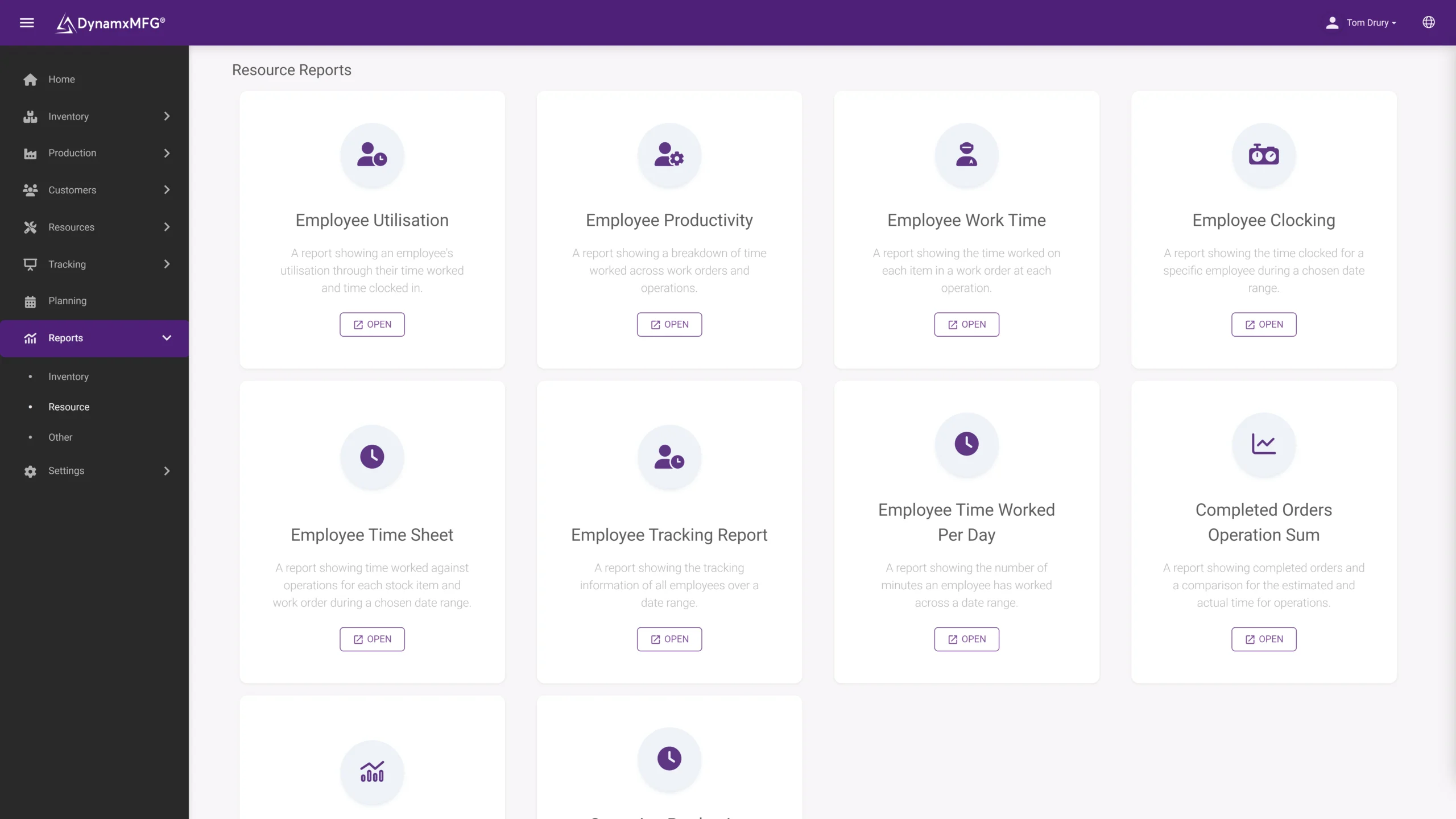
Pick a serial, a batch or a job and pull its complete chain: the material lots in, the operations and operators through, the customer out. The reporting suite runs it as a search, not a project.
Over 40 built-in reports mean the evidence pack an auditor wants is an export, not a fortnight.
- Forward and backward from any point
- Operator, machine and time on every step
- Evidence exported in minutes
How it works
How traceability is built
The chain is only as strong as its weakest capture point. Most factories have one obvious gap.
Capture at goods in
Material arrives with a batch or lot number, which is recorded against the delivery. Miss this and everything downstream is guesswork.
Bind material to the job
As material is issued to a works order, the link between that lot and that job is recorded automatically.
Record the process
Operator, machine, times, test results and any non-conformance are captured against the job at each operation.
Link to the customer
Despatch records which finished items went to which customer on which date, completing the forward half of the chain.
Capabilities
What traceability software gives you
Backward trace
From a finished item to every material lot and process that made it.
Forward trace
From a material lot to every job, product and customer it reached.
Genealogy through levels
Traceability that survives sub-assemblies rather than stopping at the top level.
Process evidence
Operator, machine, times and test results attached to the record.
Certificate generation
Material certs and evidence packs produced rather than assembled by hand.
Retention
History kept for the decades some sectors require, and still searchable.
Where it starts
The chain is built at goods in
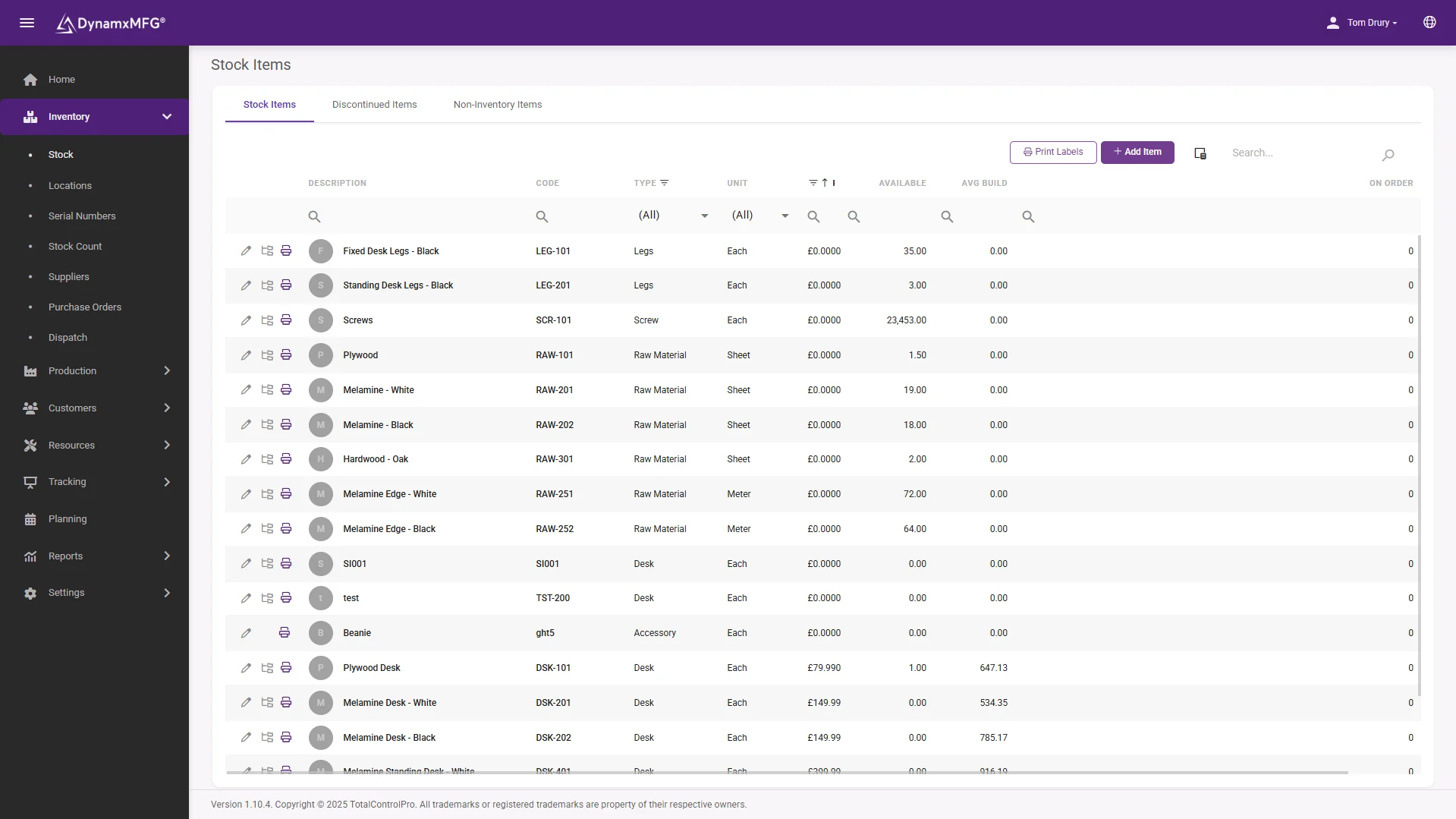
Batch numbers captured at the door follow material through allocation, issue and build. The chain exists because the work was booked, not because somebody kept a log.
Stock and traceability are the same records in DynamxMFG, which is why neither has gaps.
- Batch captured at receipt and issue
- Genealogy through sub-assemblies
- Quarantine any lot instantly
Benefits
What traceability protects
Traceability costs a little every day and saves an enormous amount on the day it is needed.
Recalls stay small
Without traceability the only safe recall is a broad one. With it, you recall the affected units. That difference is frequently the difference between an incident and a crisis.
Approvals stay intact
Aerospace, medical and automotive customers audit this specifically. Losing an approval because evidence could not be produced costs far more than the system.
Disputes get settled
When a customer claims a failure is your fault, the process record either supports them or does not. Either way the argument ends quickly.
Suppliers get held to account
Tracing a defect back to a specific supplier lot turns a vague quality conversation into a specific one with evidence attached.
Levels
How much traceability do you need?
Three levels, increasing in effort and in precision. Most manufacturers need different levels for different products.
| Serial level | Batch or lot level | |
|---|---|---|
| Granularity | Every individual unit | A group made or received together |
| Recall scope | The exact units affected | Everything from the affected batch |
| Capture effort | A scan at each operation | A scan at goods in and issue |
| Typical sectors | Aerospace, medical devices, vehicles | Food, chemicals, coatings, textiles |
| Cost to run | Higher | Lower |
| Read more | Serial number tracking | Batch tracking |
Right for you?
When traceability stops being optional
For a lot of UK manufacturers this is now a condition of supply rather than a differentiator.
- You supply into aerospace, defence, medical, automotive, food or pharmaceutical chains.
- You hold ISO 9001, AS9100 or ISO 13485 and have to demonstrate traceability at audit.
- A customer has asked for material certificates or a full build history and it was painful to produce.
- You have had a quality escape and could not quickly establish how far it spread.
- Your products carry warranty exposure and you need to prove what left the factory.
- You buy material from multiple suppliers for the same part and need to tell them apart afterwards.
DynamxMFG
A chain that builds itself
Traceability implemented as a separate exercise never survives. If it means somebody filling in an additional log, the log will be complete during the quiet weeks and full of gaps during the busy ones, which are exactly the weeks the problems come from.
DynamxMFG builds the chain out of normal work. Material is scanned as it is issued, operators book operations, despatch records what shipped. The genealogy exists because the job was run, not because anybody maintained it.
Captured at the operation
Material, operator and machine linked as work happens. See shop floor data capture.
Searchable both ways
Trace forward or backward from any lot or unit in seconds.
Evidence on demand
Export the pack for an auditor or a customer without assembling it by hand.
Integrations
Connects to what you already run
Traceability evidence often ends up in customer portals and certificates. DynamxMFG exports cleanly to Excel and connects to your document flow, so the pack goes where it is needed.
See all 33 integrations →



Customers
What manufacturers say about DynamxMFG
“DynamxMFG is an excellent choice for manufacturers looking to digitise operations without being overwhelmed by complexity.”
“As GMC has grown, it had become harder for me to have such a keen view on components to see if those parts were profitable or not. DynamxMFG enabled us to monitor the machine time and see whether we are making a profit or a loss on each component.”
“The ability to dynamically modify BOMs after release, adding or removing items from work orders, scrapping and reworking parts, has been the single biggest improvement for our business.”
“We chose the system over competitors because of its ease of use, strong customer support and friendly delivery team. So far, everything has matched what was promised.”
“With DynamxMFG, all our production processes are tracked and the relevant data is captured. This increases our control over the business and helps us identify more opportunities to enhance efficiency and quality.”
“Our experience has been positive, and it was definitely worth switching. The support we have received has been extremely helpful. My favourite feature is the integration and automation capabilities.”
Questions
Traceability questions, answered
What is the difference between forward and backward traceability?
Backward tracing starts at a finished product and finds what went into it, which identifies causes. Forward tracing starts at a material lot and finds everything it ended up in, which identifies who is affected. A recall needs both.
Does ISO 9001 require traceability?
It requires traceability appropriate to your product and risk, not a specific method. Sector standards are more prescriptive: AS9100 and ISO 13485 both expect it at unit level for critical parts.
How long do we need to keep records?
Long enough to cover product life and liability, which in aerospace and medical devices can be decades. Customer contracts often demand longer retention than regulation does.
Can we trace through sub-assemblies?
You need to, and this is where a lot of systems quietly fall down. If genealogy stops at the top level you cannot answer questions about a component two levels down.
What if a supplier does not provide batch numbers?
Then your chain starts broken and no software will fix it. Requiring batch identification at goods in is usually a purchasing conversation before it is a software one.
How fast should a trace be?
Minutes. Several customer standards specify a maximum response time for traceability requests, and a manual system will not meet it under pressure.
Related reading
Read next
Background reading on traceability software from the DynamxMFG glossary and blog.
Trace one of your products end to end
Book a 30 minute call and we will follow one of your parts backwards to its material and forwards to its customer.


