
Batch tracking
Batch Tracking Software
Batch tracking and lot traceability software records which lot of material went into which products, so a supplier problem becomes a specific list of affected items rather than a guess and a full quarantine.
Definition
What Is Batch Tracking and Lot Traceability Software?
Batch tracking, also called lot tracking, records material at the level of the group it was produced or received in. Each delivery or production run carries a batch number, and every product made from it is linked to that number.
It is the practical middle ground in traceability. Serialising every unit is expensive and only justified for high-value or safety-critical products. Batch tracking gives you a defensible chain at a fraction of the capture effort, which is why it dominates food, chemicals, coatings and textiles.
The value of batch tracking is measured on the day a supplier tells you a delivery was out of specification. Without it, everything made in a plausible date range is suspect. With it, you know precisely which jobs consumed it.
See it live
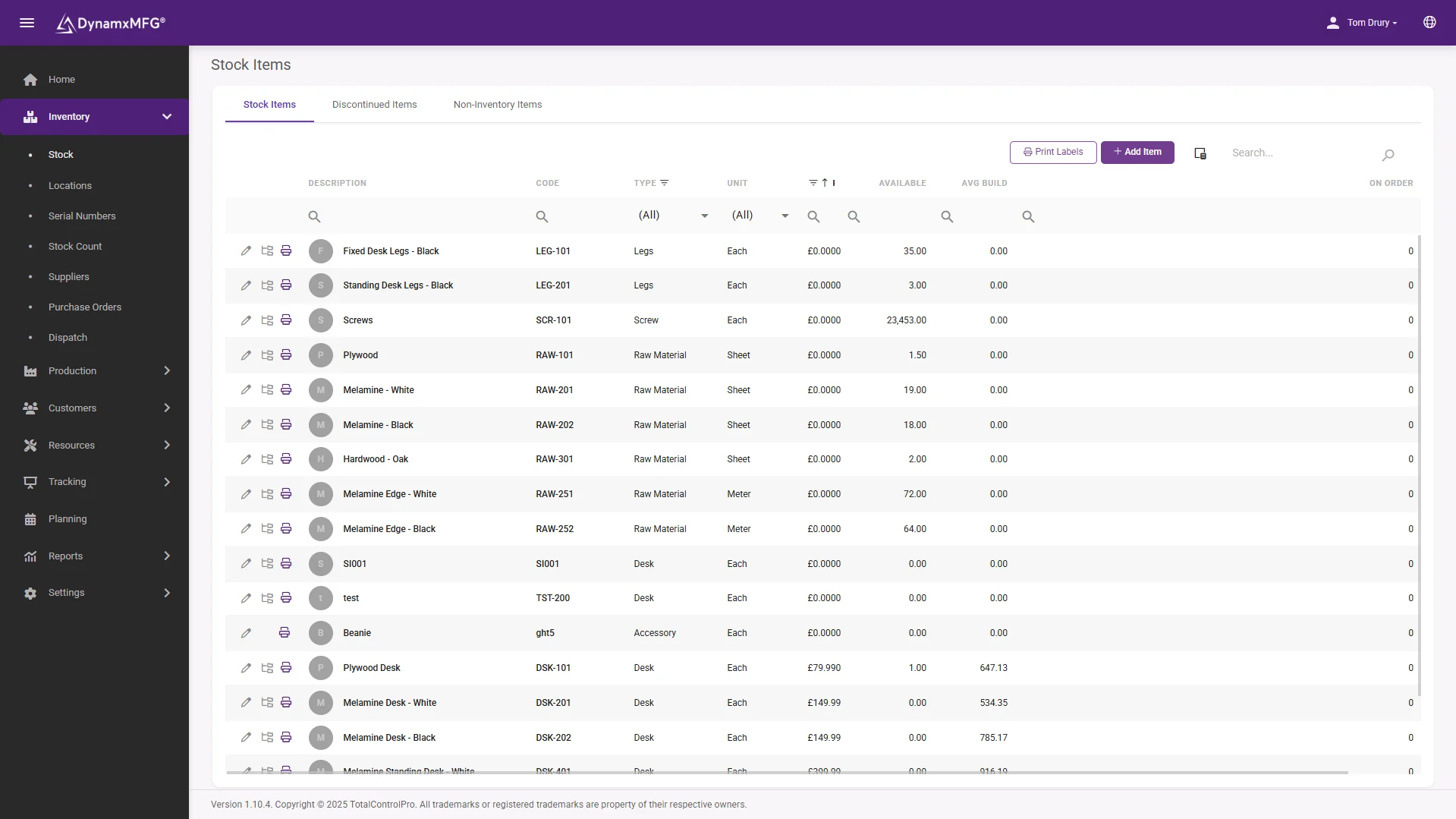
Batches on the shelf, batches in the build
Stock is held by batch and location, selected at issue with a scan. Which lot went into which job stops being a reconstruction and becomes a record.
Expiry dates ride along, so first-expired-first-out happens by default instead of by memory.
- Batch and lot per location
- Scan at issue links lot to job
- Expiry driven consumption
How it works
How batch tracking works
Three capture points. Miss any one and the chain has a hole in it.
Batch recorded at goods in
Material arrives and its supplier batch or lot number is recorded against the delivery and the stock location it goes to.
Batch selected at issue
When material is issued to a works order, the specific batch is scanned, creating the link between that lot and that job.
Own batch on output
What you produce is given its own batch number, linked to the input batches that made it, so the chain survives through sub-assemblies.
Batch recorded at despatch
Which output batches went to which customers, which is what turns a quality problem into a specific customer list.
Capabilities
What batch tracking gives you
Batch genealogy
Which input lots went into which output batches, through every level.
Where-used enquiry
Every job and product that consumed a given supplier lot.
Customer exposure
Which customers received product from an affected batch.
Expiry and shelf life
Batches tracked by date so material is consumed in the right order.
Quarantine and hold
Block a batch from being issued the moment it is suspect.
Certificates
Supplier certs of conformity held against the batch that arrived.
When it matters
From suspect lot to affected customers
The where-used enquiry takes a supplier batch and returns every job, product and customer it touched. That is a recall scoped in minutes.
Quarantine blocks the lot from further issue the moment the supplier calls.
- Where-used in one search
- Customer exposure listed instantly
- Hold and quarantine per lot
Benefits
What batch tracking is worth
Almost all of the benefit is concentrated in the small number of days when something has gone wrong.
Recalls become targeted
Instead of withdrawing three months of production, you withdraw what came from the affected lot. The saving on a single event usually exceeds the cost of the system.
Quarantine gets precise
Suspect material can be blocked instantly and you can see immediately what has already been consumed and where it went.
Supplier claims get evidence
A defect traced to a specific supplier lot is a claim you can substantiate rather than a conversation about probabilities.
Shelf life stops being wasted
Batch dates enforce first-expired-first-out, which quietly removes a category of write-off in any business handling perishable material.
Batch vs serial
Batch tracking or serial number tracking?
Both are traceability. They differ in resolution, in cost to operate, and in what they let you do when something goes wrong.
| Batch tracking | Serial number tracking | |
|---|---|---|
| Tracks | A group made or received together | Each individual unit |
| Capture effort | Lower, scan at goods in and issue | Higher, scan at every operation |
| Recall precision | Everything from the affected batch | Only the exact units affected |
| Best for | Bulk material, consumables, coatings, food | High value, safety critical, field serviced |
| Typical sectors | Food and drink, chemicals, textiles, composites | Aerospace, medical devices, electronics, vehicles |
| Can you use both | Yes, and most manufacturers should, on different products | Yes, serialised product built from batched material |
Most manufacturers end up running both. Raw material such as bar, sheet, resin or fasteners is tracked by batch, because that is how it arrives and how suppliers record it. Finished units that go into the field, get serviced or carry a warranty are given serial numbers, and each serial is linked back to the batches it was built from.
If you need unit-level history for every finished product, read our guide to serial number tracking software. If the risk sits mainly in the material you buy, batch tracking gives you most of the protection for far less capture effort.
Recall example
A Batch Traceability Recall, Step by Step
Here is how a suspect batch of material is traced when every batch has been captured at goods in, issue and despatch.
1. Find the Lot
A supplier calls to say one batch of steel bar may be out of specification. You search for that supplier batch and find where it was booked in at goods in, with the certificate stored against it.
2. Stop Further Use
Put the batch on hold. Quarantine blocks it from being issued to any further works orders, so nobody pulls it from the rack while you investigate.
3. Run Where-Used
The where-used enquiry returns every job and product that consumed that batch, including sub-assemblies that carry their own batch numbers linked back to it.
4. List Exposed Customers
From those jobs you get the customers who received product made from the suspect batch. That is the list you contact, and everything else carries on shipping.
Without batch tracking, the same phone call starts a very different week. Someone works out roughly when the steel arrived, then treats everything made from that grade since then as suspect. Stock gets quarantined wholesale, customers get a broad and vague notice, and the supplier claim rests on dates and memory rather than a record.
The difference is scope. With the chain recorded, you act on the jobs that consumed one batch. Without it, you act on everything that might have.
Buyer's guide
What to Look for in Batch Tracking Software
Most systems claim traceability. These are the questions that separate a record you can rely on from one that falls apart on the day you need it.
Capture at the point of work
Batch numbers should be recorded as material is booked in and issued to the job, as part of the operator's normal task. If capture relies on paper that gets typed up later, the record will have gaps.
Genealogy through every level
Check that outputs get their own batch number linked to their inputs, so you can trace a raw material through sub-assemblies into the finished product and back again.
Fast where-used enquiry
Ask to see a supplier lot searched live in a demo. You want every job, product and customer it touched from one search, not a report someone has to build.
Hold and quarantine
A suspect batch should be blockable from issue straight away, with a clear view of what has already been consumed.
Certificates stored against the batch
Supplier certificates of conformity and mill certs should sit against the batch that arrived, so they can be produced for an audit or customer query without a filing hunt.
Tracking only where it matters
You should be able to batch track some materials and not others, so consumables do not add capture effort for no return.
UK manufacturing
Lot Traceability for UK Manufacturers
ISO 9001 asks manufacturers to control the identification and traceability of outputs where traceability is a requirement. In practice that means being able to show an auditor how a product is linked to the material and processes that made it, and batch records are the usual way to do that for purchased material.
Customer requirements often go further. Defence, aerospace and automotive customers commonly flow traceability clauses down through their purchase orders and quality terms, and expect you to pass the same obligations on to your own suppliers. If a clause asks for material provenance, you need a record, not a best guess.
For metals, that record usually starts with the mill certificate. Storing each certificate against the batch you booked in is what lets you prove which cert covers which part. Storing the cert against the batch keeps that link in one place from goods in to despatch.
Check your own customer contracts and quality manual for the exact traceability you are required to keep. The requirement varies by customer and sector.
Right for you?
When you need batch tracking
If material arrives with a lot number on the label, somebody upstream expects you to be recording it.
- You buy material that carries supplier batch numbers.
- You work in food, drink, chemicals, coatings, composites or textiles.
- You have shelf life or expiry dates to manage on raw material.
- A customer or standard requires you to demonstrate material provenance.
- You have had to quarantine far more stock than was probably affected.
- Your products are made from material that is visually identical between suppliers.
DynamxMFG
Batch capture as part of the job
Batch tracking fails when it is a separate record. If capturing a lot number means writing it on a sheet that gets typed up later, the record will be incomplete exactly when it matters, because the busy weeks are the ones where the extra step gets skipped.
DynamxMFG captures the batch at the moment material is issued to the job. It is one scan inside work the operator is already doing, which is why the chain stays complete when the factory is under pressure.
Scanned at issue
Batch captured as material goes to the job. See inventory management.
Linked to the works order
Material, job, operator and machine held together. See works order software.
Traceable both ways
Part of full traceability, forwards and backwards.
Integrations
Connects to what you already run
Batch data starts at purchasing and ends at despatch. DynamxMFG connects the whole path and passes the commercial records to your accounts stack.
See all 33 integrations →













Customers
What manufacturers say about DynamxMFG
“DynamxMFG is an excellent choice for manufacturers looking to digitise operations without being overwhelmed by complexity.”
“As GMC has grown, it had become harder for me to have such a keen view on components to see if those parts were profitable or not. DynamxMFG enabled us to monitor the machine time and see whether we are making a profit or a loss on each component.”
“The ability to dynamically modify BOMs after release, adding or removing items from work orders, scrapping and reworking parts, has been the single biggest improvement for our business.”
“We chose the system over competitors because of its ease of use, strong customer support and friendly delivery team. So far, everything has matched what was promised.”
“With DynamxMFG, all our production processes are tracked and the relevant data is captured. This increases our control over the business and helps us identify more opportunities to enhance efficiency and quality.”
“Our experience has been positive, and it was definitely worth switching. The support we have received has been extremely helpful. My favourite feature is the integration and automation capabilities.”
Questions
Batch tracking questions, answered
What is the difference between a batch and a lot?
Nothing meaningful in most UK factories. Batch tends to be used for what you produce, lot for what you receive, but the terms are used interchangeably and mean a quantity handled as one group.
Can we batch track some materials and not others?
Yes, and most manufacturers should. Track material where provenance matters or where a defect would be expensive. Tracking every consumable adds capture effort for very little return.
How does batch tracking work through sub-assemblies?
Each output gets its own batch number linked to the input batches that made it. Without that, the chain breaks at the first level and you cannot trace a raw material into a finished product.
Is batch tracking enough for aerospace?
For some material, yes. For critical parts, aerospace customers generally expect unit-level traceability, which means serial numbers.
What about material with no batch number?
You can assign your own at goods in, keyed to the delivery. It is less useful than a supplier batch because it will not correlate with the supplier's own records if they have a problem.
Does this handle expiry dates?
Yes. Batches carry dates, and issue can be driven first-expired-first-out so shelf life is consumed in the right order rather than by whatever is nearest the door.
What is lot traceability?
Lot traceability is the ability to follow a lot of material forwards into the products and customers it reached, and backwards from a product to the lots it was made from. It relies on recording the lot at goods in, at issue to each job and at despatch.
Do ISO 9001 manufacturers need batch tracking?
ISO 9001 requires you to control traceability where it is a requirement, for example from a customer, regulator or your own quality system. It does not name batch tracking, but batch records are the most common way to meet that requirement for purchased material.
How is a recall scoped with batch tracking?
You find the suspect lot, put it on hold, run a where-used enquiry to list every job and product that consumed it, then list the customers who received that product. The recall covers those customers only, rather than everything made in a date range.
Related reading
Read next
Background reading on batch tracking software from the DynamxMFG glossary and blog.
See a batch traced through a build
Book a 30 minute call and we will follow one of your material lots into the jobs that consumed it and out to the customers who received them.


