
Production control
Production control software
Know what every job on the floor is doing right now, spot the ones slipping before the customer does, and stop running the factory on a plan that stopped being true on Tuesday morning.
Definition
What is production control software?
Production control software manages work once it has been released to the floor. Planning decides what should happen; production control is concerned with what is actually happening, and with closing the gap between the two while there is still time to act.
It covers releasing works orders, tracking them through each operation, recording labour and material against them, flagging the ones running behind, and giving everyone from the cell leader to the managing director the same picture of where things stand.
The test is simple. If someone rings up asking where their order is, can you answer from a screen, or does somebody have to walk the floor and find out? One of those is production control. The other is a fire drill.
See it live
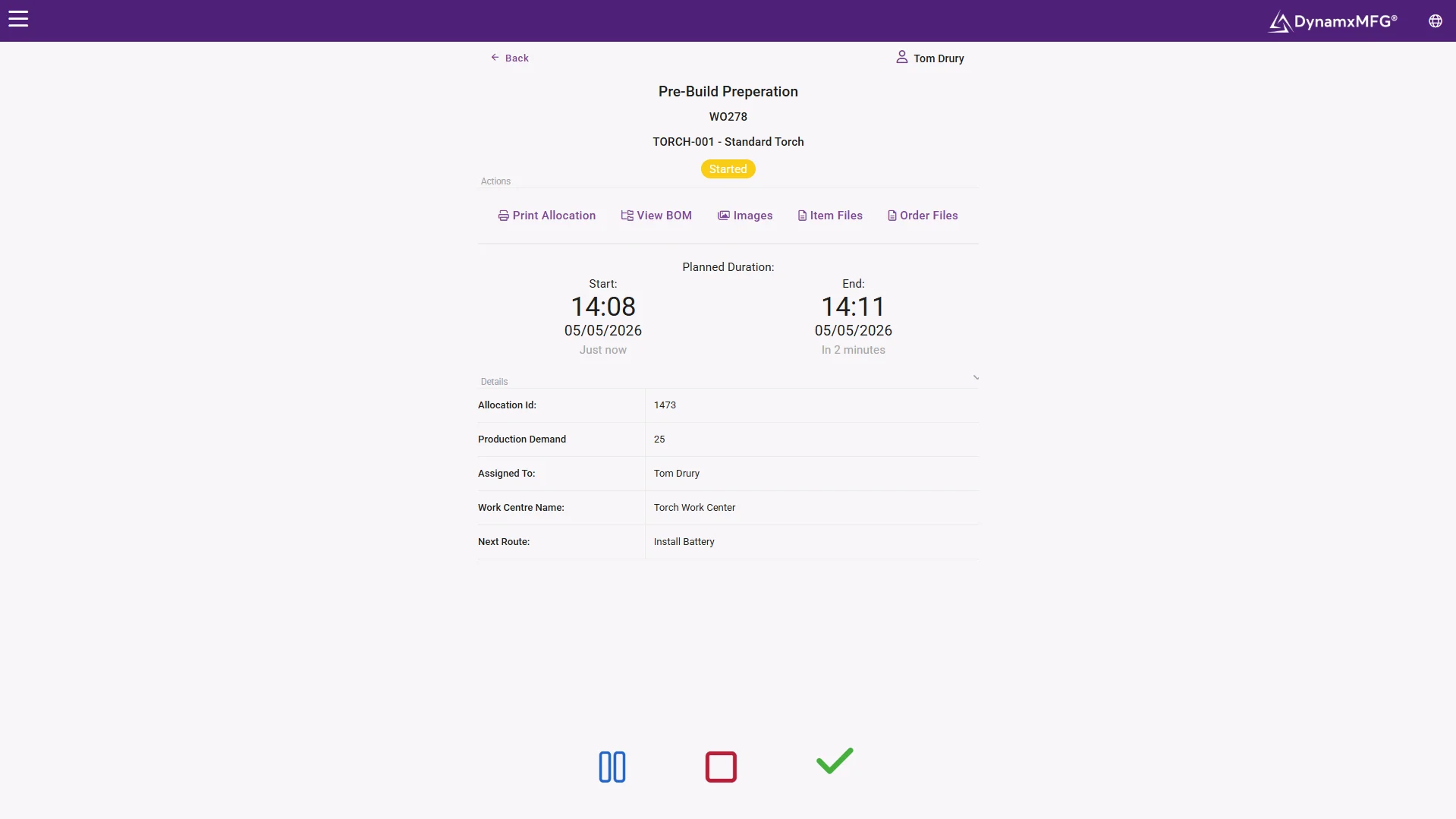
The whole floor on one screen
Every live works order, the operation it is at, who is booked on and how long it has been there. This is the view your morning meeting has been trying to assemble by hand.
Supervisors see their own cell's queue on the terminal. The office sees the whole order book. Both are looking at the same bookings, updated the moment they happen.
- Every job by operation, live
- Queue and dwell time at each work centre
- Late and stalled jobs flagged automatically
How it works
How production control works
Control is a loop, not a report. Break any part of it and you are back to managing by walking around.
Release the work
Jobs are issued to the floor with the routing, drawings and material attached, so the operator has everything needed to start without hunting for paperwork.
Capture as it runs
Operators book on and off each operation. Time, quantity, scrap and operator are recorded at the point of work rather than written on a card and typed up at the end of the week.
Compare against plan
Every booking is measured against the expected time and the promised date. Jobs drifting from plan surface automatically instead of being discovered at the despatch bay.
Act on the exceptions
Nobody has time to review 300 live jobs. What matters is the twenty that are late, blocked or over-running, pushed to the people who can do something about them.
Capabilities
What production control gives you
Live job status
Every works order, at every operation, with the time booked against it so far.
Exception flagging
Late, blocked and over-running jobs raised automatically rather than found by chance.
Labour and material capture
What each job consumed in hours and stock, recorded as it happens.
Operation-level progress
Not just started or finished, but which of the eleven steps the job has reached.
Queue visibility
What is waiting at each work centre and how long it has been sat there.
Delivery confidence
A promised date you can defend, because it comes from real capacity and real progress.
Evidence, not opinions
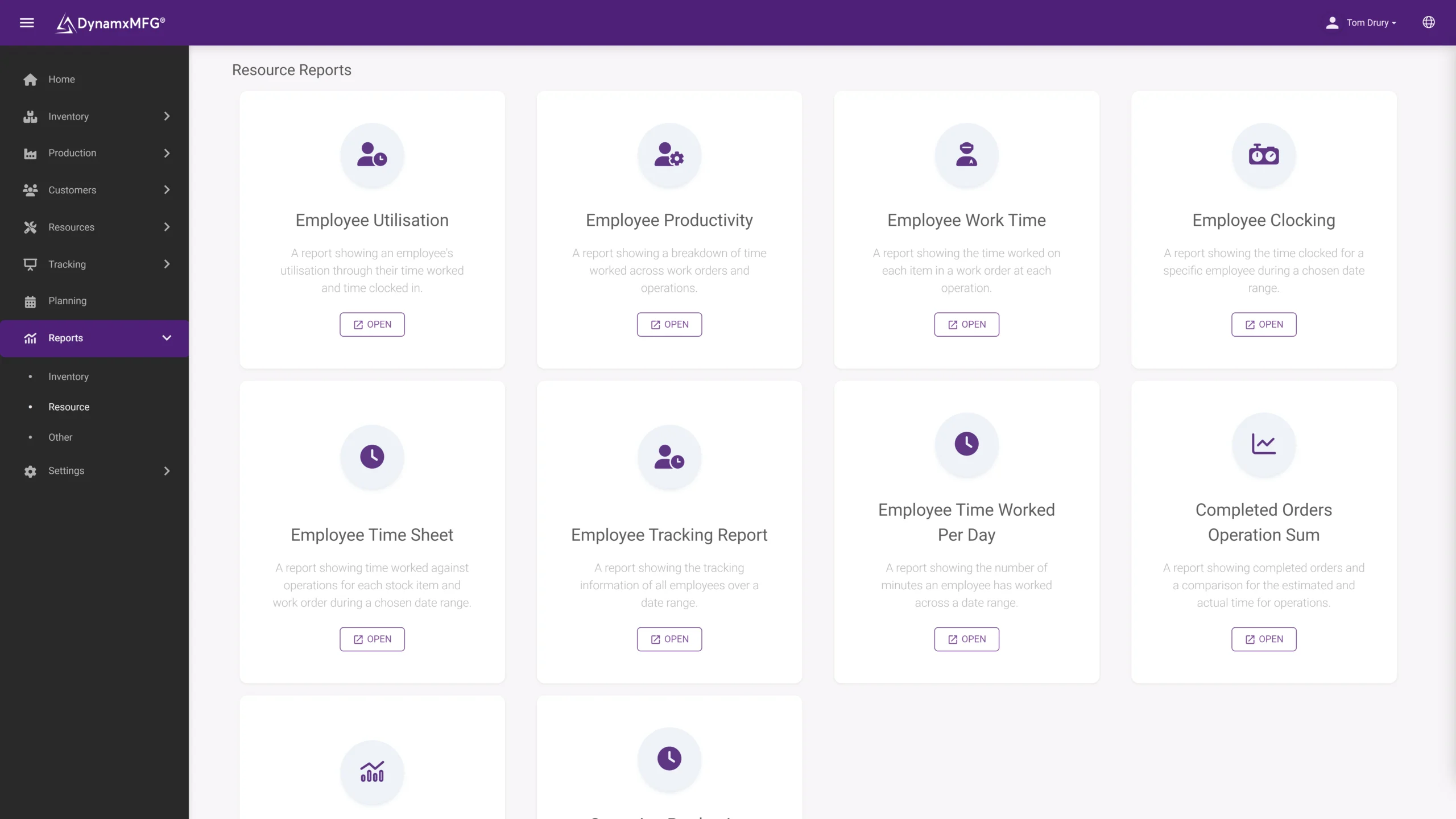
Reports that build themselves
Because control runs on real bookings, the reporting is a by-product. Delivery performance, booked hours, downtime and scrap come straight out of the same data that ran the floor.
Over 40 built-in reports run from live production data, so the Monday pack stops being somebody's Friday afternoon job.
- Delivery performance by customer and product
- Booked time against planned, per operation
- Export to Excel or Power BI
Benefits
What changes on the floor
Production control does not make the factory faster on its own. It removes the guesswork that makes a factory slow.
The chase stops
Sales answer customer questions from a screen. Nobody walks the floor to find a job, and the office stops interrupting the people building things.
Problems surface early
A job that has not moved in two days is visible on day two, not at the delivery date. That is what live shop floor WIP tracking is for. Most late deliveries are late because nobody noticed in time.
Estimates get honest
Booked times feed back into quoting. The gap between what you thought a job took and what it actually took stops being a mystery.
Firefighting becomes rarer
When the exceptions are surfaced automatically, the working day stops being driven by whichever customer shouted loudest this morning.
Planning vs control
Production planning or production control?
They are different jobs and most factories need both. Planning sets the intent. Control deals with reality.
| Production control | Production planning | |
|---|---|---|
| Question it answers | What is happening right now? | What should we make and when? |
| Horizon | Today and this week | Weeks to months ahead |
| Owned by | Cell leaders, supervisors, production managers | Planners, operations managers |
| Data it needs | Live bookings from the floor | Demand, stock, capacity, lead times |
| Updates | Continuously, as work is booked | On a planning cycle |
| Fails when | Capture is done at end of shift, not at the operation | Stock and capacity figures are wrong |
Right for you?
When you need production control
Most factories reach for this at the point where the whiteboard stops coping.
- You cannot answer where is my order without asking somebody to go and look.
- Jobs are found to be late at the despatch bay rather than three operations earlier.
- Your job progress lives on a whiteboard, a spreadsheet or in one person's head.
- You run high-mix, low-volume work where every job takes a different route.
- Overtime is being approved reactively because nobody saw the overload coming.
- You are quoting from standard times that nobody has checked against reality in years.
DynamxMFG
Production control that does not need chasing
The reason production control fails in most SME factories is not the concept, it is the data entry. Any system that asks operators to fill something in after the fact will be out of date within a fortnight, and then everybody goes back to the whiteboard.
DynamxMFG captures progress as part of the work itself. The operator scans the job, books the operation, records the quantity. There is no separate admin step, so the picture on screen stays true without anybody maintaining it.
Built into the operation
Booking happens on shop floor terminals as part of running the job. See shop floor data capture.
Every job, every step
Live status by operation across the whole order book. See order management.
Exceptions pushed to you
Late and blocked jobs surfaced in manufacturing intelligence rather than hunted for.
Integrations
Connects to what you already run
Production control does not replace your accounts package, it feeds it. DynamxMFG connects to Sage, Xero, QuickBooks and the rest of your stack, so job and stock data lands where the money lives without rekeying.
See all 33 integrations →











Customers
What manufacturers say about DynamxMFG
“DynamxMFG is an excellent choice for manufacturers looking to digitise operations without being overwhelmed by complexity.”
“As GMC has grown, it had become harder for me to have such a keen view on components to see if those parts were profitable or not. DynamxMFG enabled us to monitor the machine time and see whether we are making a profit or a loss on each component.”
“The ability to dynamically modify BOMs after release, adding or removing items from work orders, scrapping and reworking parts, has been the single biggest improvement for our business.”
“We chose the system over competitors because of its ease of use, strong customer support and friendly delivery team. So far, everything has matched what was promised.”
“With DynamxMFG, all our production processes are tracked and the relevant data is captured. This increases our control over the business and helps us identify more opportunities to enhance efficiency and quality.”
“Our experience has been positive, and it was definitely worth switching. The support we have received has been extremely helpful. My favourite feature is the integration and automation capabilities.”
Questions
Production control questions, answered
What is the difference between production control and an MES?
Production control is the discipline. An MES is the software category that delivers it, usually alongside quality, traceability and performance measurement. In practice most people searching for production control software end up buying an MES.
Do I need to replace my accounting system?
No. Production control sits on the shop floor and hands finished figures to finance. Keeping Sage, Xero or QuickBooks for the books and adding production control on top is the normal pattern for UK SMEs.
How is this different from a whiteboard?
A whiteboard shows the plan. It cannot tell you that operation four started ninety minutes late, cannot warn you about it, and cannot tell you afterwards what the job cost. It also only exists in one room.
Will operators actually use it?
They will if booking a job is faster than the paperwork it replaces. If it is slower, they will not, and no amount of policy will fix that. Judge any system on how many taps it takes to book an operation.
How long does it take to get running?
A focused shop floor rollout is a matter of weeks rather than the multi-year ERP programmes people fear. DynamxMFG is deployed in 90 days.
Does it work for one-off and bespoke jobs?
Yes, and that is usually where it earns most. High-mix, low-volume work is exactly the environment where nobody can hold the state of the factory in their head.
Related reading
Read next
Background reading on production control software from the DynamxMFG glossary and blog.
See your own order book on one screen
Book a 30 minute call and we will show you live job tracking using your products and your routings as the example.


