
Stock control
Stock control software for manufacturers
Know what is on the shelf, what is committed to jobs and what is genuinely free to promise, without a stock take to find out.
Definition
What is stock control software for manufacturing?
Stock control software tracks the material a factory holds: raw material coming in, components allocated to jobs, work in progress on the floor and finished goods waiting to ship. It records every movement so the figure on screen matches the figure on the shelf.
Manufacturing stock control differs from retail or distribution stock control in one important way. Material does not just arrive and leave, it gets consumed and transformed. A sheet of steel becomes four brackets, and the system has to understand that.
The number that matters is not what you hold, it is what is free. Stock that is physically present but already committed to next week's jobs is not available, and treating it as though it is causes most of the shortages that stop production.
See it live
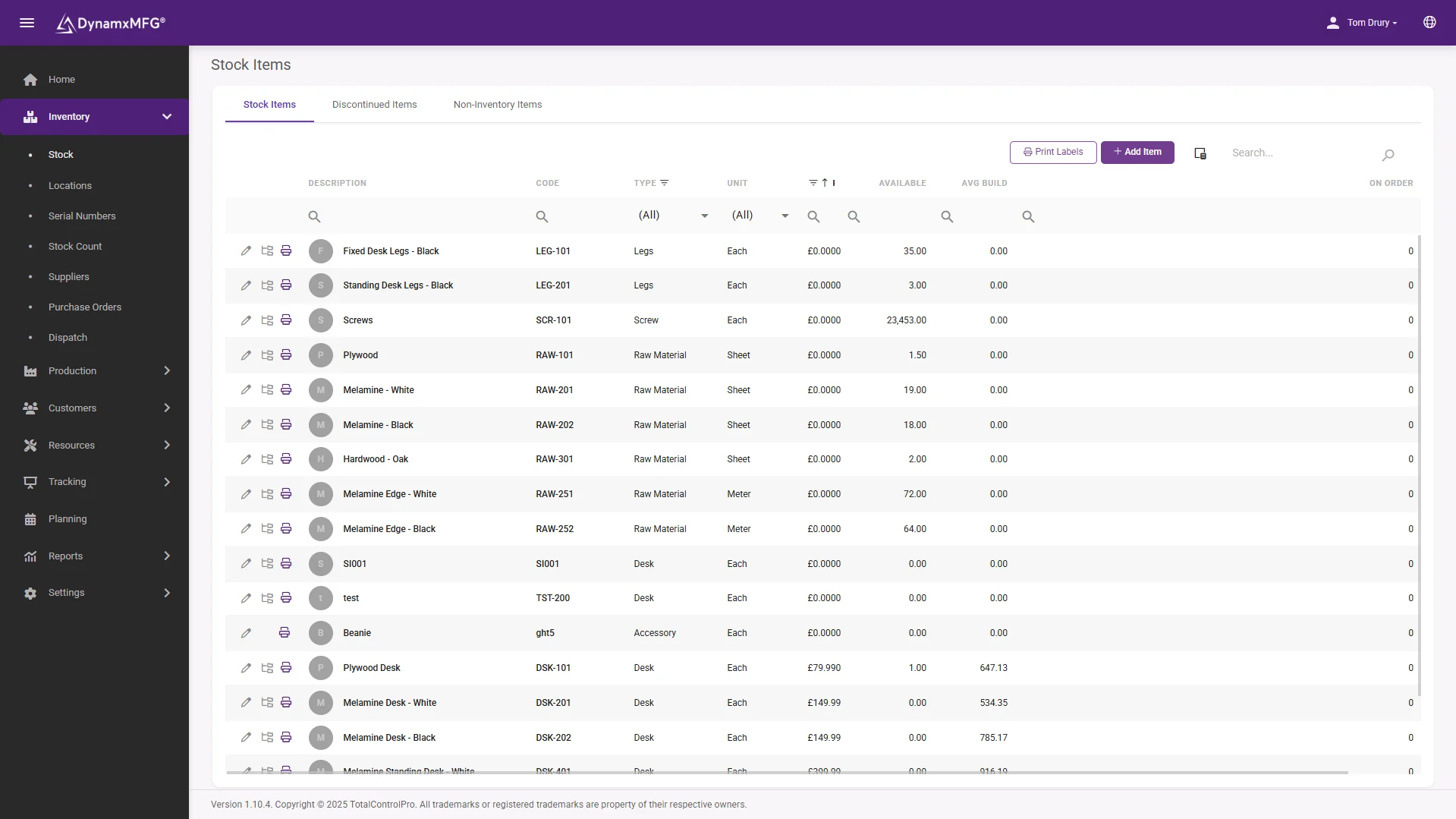
Free stock you can actually promise against
Physical, allocated and free, by location, with batch numbers attached. The figure on screen matches the shelf because issues happen at the job, not at month end.
Reorder levels flag replenishment before the shortage, not after the stopped job.
- Free vs committed at a glance
- Multi-location with batch and lot
- Reorder points that fire early
How it works
How manufacturing stock control works
Four movements account for almost everything that happens to material in a factory.
Goods in
Material is received against a purchase order, checked, and booked to a location with its batch or lot number recorded.
Allocation
When a works order is raised, the material it needs is reserved. It is still physically present but no longer free to promise elsewhere.
Issue to job
Material is booked out to the works order as it is consumed, which is the point where stock and job cost both update.
Finished goods and despatch
Completed items are booked in as finished stock and then out again on despatch, closing the loop.
Capabilities
What stock control gives you
Free versus committed
What you actually have available, not just what is physically present.
Multi-location
Stores, cells, subcontract and vans, tracked separately rather than as one pile.
Batch and lot control
Material traceable from goods in through to the job that consumed it.
Reorder levels
Minimum and maximum levels that flag replenishment before you run out.
Stock valuation
What your inventory is worth, on a consistent basis, at any point.
Cycle counting
Rolling counts by value or movement instead of an annual shutdown.
Closing the loop
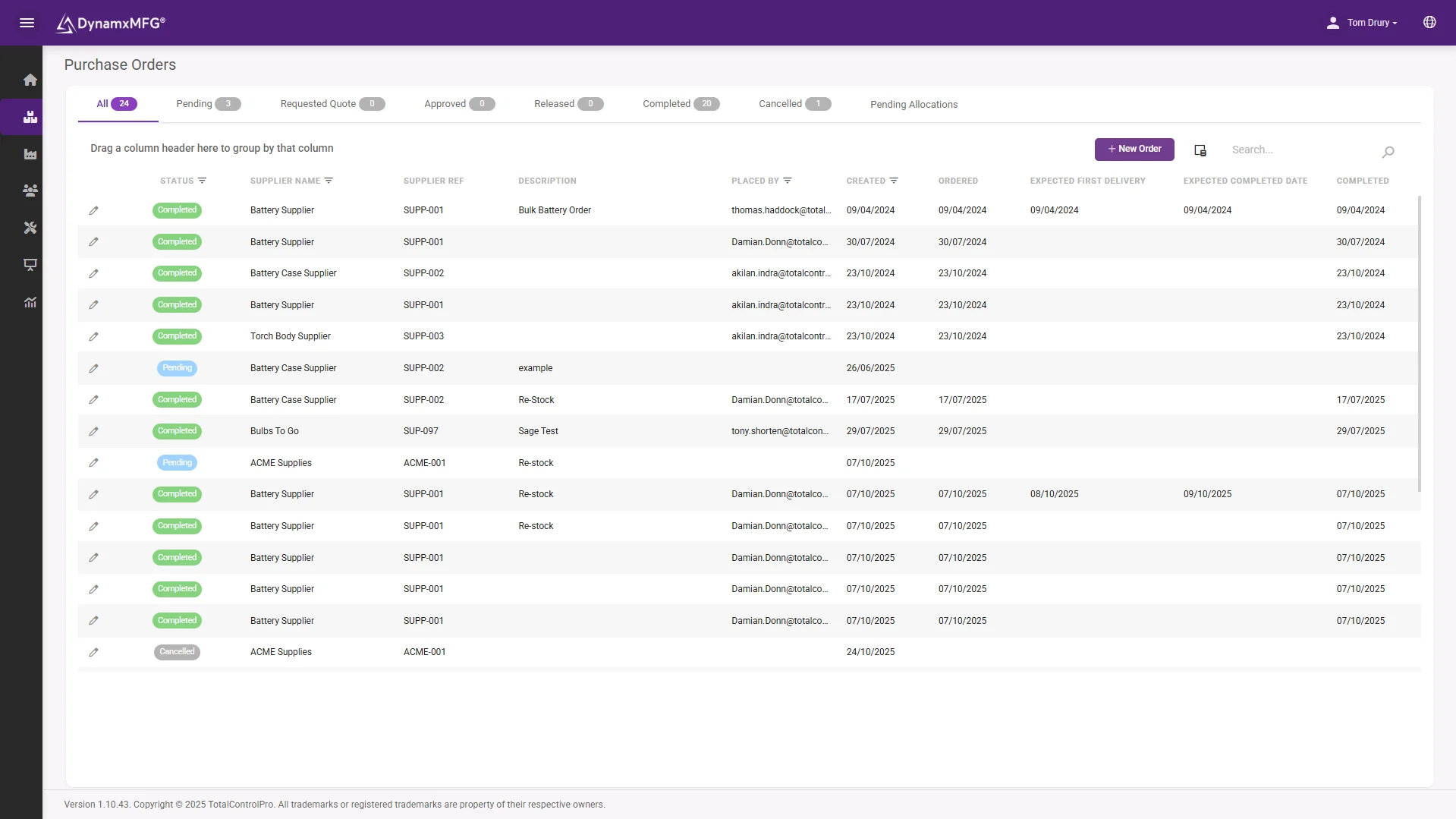
Purchasing that lands back into stock
Goods in books against the purchase order, captures the batch and updates free stock in one action. What is on order and when it lands is part of the same picture.
Late deliveries surface with the jobs they will stop, which turns chasing into prioritising.
- Goods in with batch capture
- On-order visibility with promised dates
- Shortages linked to affected jobs
Benefits
What accurate stock is worth
Stock accuracy is the foundation the rest of a manufacturing system stands on. Below about 95 per cent, planning output stops being believable.
Jobs stop stalling
The commonest reason a job stops mid-route is one missing component that the system thought was in stores. Accurate stock removes most of those.
Cash comes off the shelf
Factories that cannot trust their stock figures carry safety stock as insurance. Accurate figures let you release that working capital deliberately.
Planning becomes credible
MRP and planning runs are only as good as the stock position they net against. Wrong stock produces a confident, wrong plan.
Stock takes get shorter
Rolling cycle counts on live data replace the annual shutdown, and the count usually agrees because movements were recorded as they happened.
Manufacturing vs distribution
Why manufacturing stock control is different
A lot of stock software is built for people who buy things and sell the same things. Manufacturers do not do that.
| Manufacturing | Distribution and retail | |
|---|---|---|
| Material is | Consumed and transformed into something else | Bought and resold unchanged |
| Needs to track | Raw material, WIP and finished goods | Finished goods only |
| Driven by | Bills of materials and works orders | Sales orders |
| Key concept | Allocation and issue to jobs | Pick and pack |
| Traceability | Batch and serial through the build | Batch at despatch, if at all |
| Costing | Material rolled into job cost | Landed cost per item |
Right for you?
When you need proper stock control
The symptoms are usually obvious and usually tolerated for years before anyone acts.
- Jobs regularly stop because a component that was supposed to be in stores is not.
- Nobody trusts the stock figure enough to promise a delivery date from it.
- Stock takes produce large adjustments that nobody can explain.
- You carry safety stock mainly because the numbers cannot be relied on.
- Material is issued to jobs without being recorded, so consumption is inferred.
- You cannot tell what a batch of material was used on without asking somebody.
DynamxMFG
Stock that updates because work happened
Most stock inaccuracy in a small factory comes from the same place: material physically moves and nothing records it. Somebody takes what they need from stores to keep a job going, entirely reasonably, and the system never finds out.
DynamxMFG issues material against the works order as part of booking the job. Because it is tied to the work rather than being a separate stores transaction, the record gets made in the situations where paper systems fail.
Issued at the job
Consumption recorded as part of running the works order. See inventory management.
Batch captured on the way
Lot numbers scanned at issue. See batch tracking.
Feeds the plan
Live free stock netting into production planning.
Integrations
Connects to what you already run
Stock value belongs in the accounts, movements belong on the floor. DynamxMFG keeps both true, feeding Sage, Xero and QuickBooks from the same movements the factory books.
See all 33 integrations →













Customers
What manufacturers say about DynamxMFG
“DynamxMFG is an excellent choice for manufacturers looking to digitise operations without being overwhelmed by complexity.”
“As GMC has grown, it had become harder for me to have such a keen view on components to see if those parts were profitable or not. DynamxMFG enabled us to monitor the machine time and see whether we are making a profit or a loss on each component.”
“The ability to dynamically modify BOMs after release, adding or removing items from work orders, scrapping and reworking parts, has been the single biggest improvement for our business.”
“We chose the system over competitors because of its ease of use, strong customer support and friendly delivery team. So far, everything has matched what was promised.”
“With DynamxMFG, all our production processes are tracked and the relevant data is captured. This increases our control over the business and helps us identify more opportunities to enhance efficiency and quality.”
“Our experience has been positive, and it was definitely worth switching. The support we have received has been extremely helpful. My favourite feature is the integration and automation capabilities.”
Questions
Stock control questions, answered
Is stock control the same as inventory management?
They are used interchangeably. Stock control is the more common UK term and tends to emphasise accuracy and movement; inventory management sometimes implies the wider planning of levels as well.
Can my accounts package do this?
It can hold stock values and simple quantities. What it generally cannot do is allocation to works orders, batch traceability through a build, or issue at the point of work.
What stock accuracy should we aim for?
95 per cent is the point at which planning output becomes trustworthy. Above 98 per cent is achievable with disciplined issue and cycle counting, and is where safety stock can safely come down.
Do we need barcodes on everything?
Not everything, but barcoding your fastest-moving and highest-value material pays for itself quickly, because those are the lines where errors cost most.
What is cycle counting?
Counting a small proportion of lines frequently, prioritised by value or movement, rather than counting everything once a year. It finds errors while they are still explainable.
How do we handle offcuts and remnants?
Either as a stock item in their own right with a location, or written off at issue. What causes trouble is the informal third option, where they sit in a corner and exist only in somebody's memory.
Related reading
Read next
Background reading on stock control software from the DynamxMFG glossary and blog.
Get your stock figure to match the shelf
Book a 30 minute call and we will walk through goods in, allocation and issue on your own material and locations.


